“We’ve got £1,000 a month for marketing. What would you actually do with it?”
Now we’re talking.
In our £500 small business marketing budget guide, we explained why trying to squeeze SEO, social media, Google Ads and everything else into a relatively small budget isn’t usually a good idea. At that level, we’d rather focus on building strong foundations than give you a tiny bit of everything just so we can sell you more services.
But what happens when you double that budget?
At £1,000 a month, things start to get more interesting.
You’ve still got to be selective – £1,000 isn’t suddenly an unlimited marketing pot – but there is enough room to keep building your long-term visibility while potentially putting some money behind generating enquiries now.
So, if a local business came to us with £1,000 a month and asked us where we’d put it, here’s where we’d start.
First, We Still Wouldn’t Spend It Until We Understood Your Business
A bigger budget doesn’t change the first question: what are we actually trying to achieve?
If you’re an electrician in Staines looking for rewires, your marketing strategy is going to look very different from a local restaurant trying to fill tables or a B2B company looking for a handful of high-value clients.
We’d want to know which services make you money, what a new customer is worth, where your customers come from and how quickly you need results.
Most importantly, we’d look at what you’ve already got.
There’s little point paying to send more people to a website that doesn’t generate enquiries. Equally, if you’ve got a good website but nobody can find it, that’s where the opportunity lies.
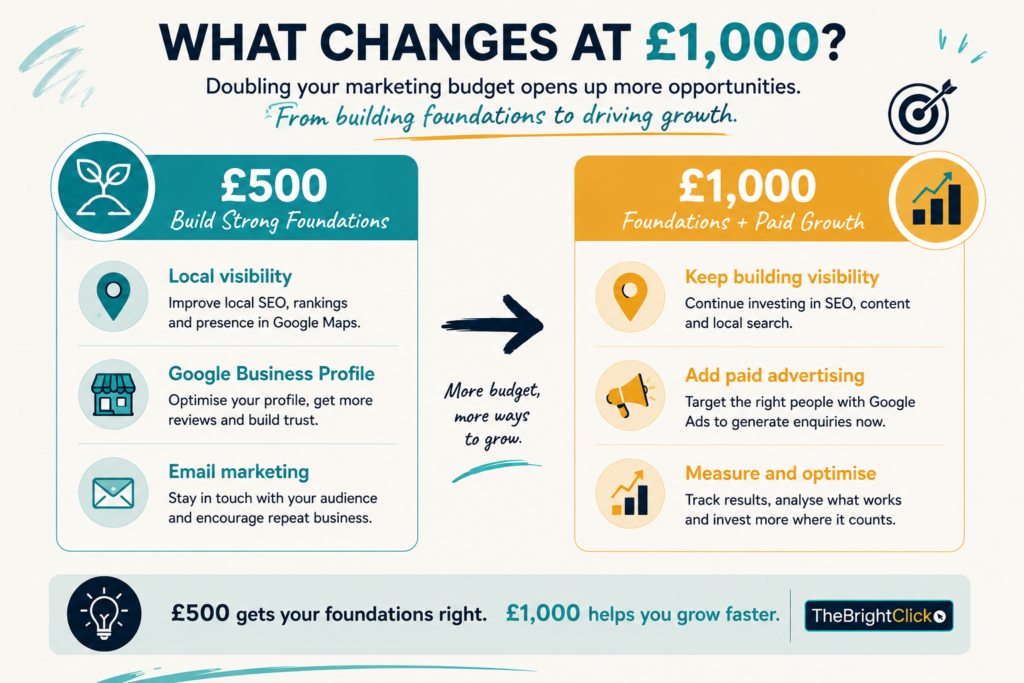
What Changes When Your Marketing Budget Reaches £1,000?
At £500 a month, our priority would be building foundations: local visibility, your Google Business Profile and making better use of customers you already have.
With a £1,000 small business marketing budget, we’d keep building those foundations – but we’d also look at whether there’s a sensible opportunity to introduce paid advertising.
That’s the important difference.
SEO helps you build visibility over time. PPC can put you in front of somebody searching for your service now.
Used together, they can do very different jobs.
We’d Keep Investing in Local SEO
We wouldn’t suddenly abandon SEO because there’s more money available.
For a business serving Staines-upon-Thames, Ashford, Egham, Chertsey, Sunbury or Shepperton, being visible when someone nearby searches for your services is still hugely valuable.
We’d continue improving the pages that matter, creating useful content around genuine searches, strengthening local signals and looking after your Google Business Profile.
Our Local SEO services focus on exactly this – helping businesses appear more prominently in Google Search, Google Maps and local “near me” searches.
For us, local SEO isn’t about trying to trick Google. It’s about making it extremely clear what your business does, where you do it and why you’re a relevant result for the person searching.
And increasingly, we’d also think beyond traditional search results. Search is changing quickly, with AI-generated results and assistants becoming another way people discover businesses. Creating genuinely useful, well-structured content gives search engines and AI systems more useful information to understand what you do.
We’d Look Seriously at Paid Advertising
This is where the £1,000 budget starts to differ from the £500 one.
We wouldn’t automatically launch Google Ads just because the budget had increased. But we’d absolutely investigate it.
If people are actively searching for exactly what you sell, the numbers stack up and there’s enough budget left after management to generate meaningful traffic, paid advertising can give you something SEO can’t: immediate visibility.
For a local campaign, we’d keep it focused. That might mean concentrating on Staines and a tightly defined surrounding area rather than trying to advertise across half of Surrey.
We’d also concentrate the spend on the services that matter most commercially rather than giving every service an equal share of the budget.
If one type of enquiry is worth £1,500 to your business and another is worth £150, that matters.
Your marketing budget should follow the opportunity.
We Wouldn’t Automatically Spend Money on Social Media
This might sound odd coming from an agency that offers social media management, but we’d only recommend putting part of the £1,000 there if it genuinely suited the business.
A restaurant, beauty business, retailer or visually interesting consumer brand might get real value from social content or targeted Meta advertising.
A specialist B2B company whose customers primarily search Google when they need help? We’d probably put the money elsewhere.
That’s the point.
We don’t believe every client needs every marketing channel.
We’d Make Sure We Can Tell What’s Working
Once you’re spending £1,000 every month, measurement becomes even more important.
We’d want to know which marketing activity is generating phone calls, forms, bookings or sales – not simply which one produced the prettiest graph.
That might mean improving conversion tracking, checking Google Analytics, reviewing search terms, monitoring local rankings and looking at lead quality.
If one part of the strategy is clearly outperforming another, we’d adjust.
A marketing budget shouldn’t be carved in stone. It should move towards what works.
What We Still Wouldn’t Do With £1,000
We still wouldn’t try to be everywhere.
We wouldn’t run tiny campaigns across Google, Facebook, Instagram and LinkedIn while simultaneously trying to fund SEO, email marketing and a brand-new website.
We wouldn’t chase clicks simply because they’re cheap.
And we wouldn’t spend every penny just because it was available.
£1,000 gives you more options. It doesn’t remove the need to choose.
So, How Would We Spend a £1,000 Marketing Budget?
There isn’t a magic percentage we’d use for every business.
For many local service businesses, we’d expect the strategy to centre around local SEO and tightly targeted paid advertising, with the exact split determined by the market, cost per click, existing website and value of a new customer.
For another business, the right answer might be SEO plus social. For another, we’d put more money into improving the website before increasing traffic at all.
That’s why we’d be wary of any agency that tells you how to divide your £1,000 before asking what you sell.
The budget comes second.
The business comes first.
The Bottom Line
£1,000 a month is enough to start building a genuinely useful small business marketing strategy.
Not an enormous one. Not one that does everything. But one capable of combining long-term growth with activity designed to generate opportunities now.
The important thing is knowing where your next £1 should go.
We’re The Bright Click, a family-run digital marketing agency based in Staines-upon-Thames, working with businesses locally and further afield. We don’t believe in selling businesses every marketing service we offer. We’d rather work out what actually makes sense for your goals and your budget.
If you’ve got around £1,000 a month to invest in marketing and you’re not sure where to put it, get in touch with The Bright Click.
We’ll tell you what we’d do with it.