Your website traffic is going up.
Lovely.
Except your inbox isn’t.
The phone isn’t ringing more often, there aren’t more quote requests coming through and all those extra visitors aren’t actually turning into business.
The obvious reaction is often: “We need more traffic.”
Maybe.
But if 500 people are visiting your website and hardly anybody is getting in touch, paying to send another 500 people to exactly the same place may simply give you twice as many people who don’t enquire.
Before we spend another penny generating traffic, we’d want to work out where the problem actually is.
Because it might be your website. But it might not.
First: Are the Right People Visiting Your Website?
This is the bit that’s easily missed.
More website traffic doesn’t necessarily mean more potential customers.
Imagine you’re a commercial accountant and you’ve published a really useful article answering a common tax question. It starts ranking well on Google and suddenly brings hundreds of visitors to your website every month.
Great for the traffic graph.
But if most of those visitors are individuals looking for a quick answer rather than businesses looking for an accountant, we’d hardly expect them all to enquire.
The same thing can happen with SEO, social media and paid advertising.
You can attract plenty of people while attracting very few potential customers.
So we’d look beyond the overall traffic number and ask: Where are people coming from? What did they search for? Which pages are they landing on? And are those people realistically likely to buy what you sell?
If the answer to that last question is no, redesigning your contact form isn’t going to solve the real problem.
You may have a traffic problem disguised as a conversion problem.
If the Traffic Is Right, Can People Immediately Understand What You Do?
Now we’d look at the website itself.
Open your homepage or one of your main service pages and pretend you’ve never seen the business before.
- What does this company actually do?
- Is it for someone like me?
- Why might I choose them?
- What should I do next?
Businesses often know their own services so well that they don’t realise how much knowledge they’re expecting a new visitor to have.
A clever headline might sound great internally but mean very little to somebody arriving from Google for the first time.
Navigation might make perfect sense to your team but leave a potential customer wondering where to go.
And pages can spend hundreds of words talking about the company without clearly explaining the problem it solves for the customer.
Your website doesn’t need to explain absolutely everything immediately. But it does need to make somebody think: “Yes. I’m in the right place.”
Are You Giving People a Reason to Trust You?
Understanding what you do isn’t enough.
Your visitor also needs to decide whether they trust you to do it.
That’s particularly important for higher-value services where somebody isn’t going to make a decision based on price alone.
Think about what a potential customer sees. Are there genuine customer reviews? Testimonials? Examples of your work? Case studies? Accreditations where they’re relevant? Real people behind the business? Evidence that you understand their particular problem?
A visitor might genuinely need what you’re selling and still leave because they haven’t seen enough to feel comfortable taking the next step.
This doesn’t mean covering every page in badges and five-star graphics.
It means answering the perfectly reasonable question running through the visitor’s head: “Why should I trust these people?”
Is the Next Step Obvious?
This sounds ridiculously simple. But we’d check it.
Once somebody decides they’re interested, what exactly are you asking them to do?
Call? Request a quote? Book an appointment? Send an enquiry? Arrange a consultation?
If the answer changes five times across the page, there’s a problem.
The same applies if your only contact button is hidden in the navigation, your telephone number isn’t clickable on mobile, or somebody has to hunt through the site to work out how to contact you.
A call to action doesn’t need to shout. It needs to be clear.
And importantly, the size of the next step should match how ready the visitor is likely to be.
Someone looking for an emergency plumber may happily Call Now.
Someone considering a £20,000 professional service may not be ready to Book a Sales Call after reading one page.
For a higher-consideration purchase, something useful that gives them a smaller first step can work better.
That might be an assessment, calculator, audit or scorecard. The principle is simple: give somebody something genuinely useful before asking them for a bigger commitment. The Bright Click’s Scorecard as a Service is one example of how a business can turn interested website visitors into warmer, better-qualified leads.
Could Your Contact Form Be Losing the Enquiry?
Someone has made it all the way to your form. Don’t make them regret it.
If you’re asking a first-time visitor for 15 pieces of information when you really need four, you’re creating work for them before you’ve done any work for them.
We’d check whether the form is easy to use on a phone, whether the questions are actually necessary, whether error messages work properly and, rather importantly, whether the form submission actually reaches somebody.
We’d also look at what happens between somebody seeing the form, starting it and actually submitting it.
If plenty of people reach the contact page but very few complete the form, that’s useful information.
That’s much more helpful than simply knowing that 1,000 people visited the website.
Check the Mobile Experience Properly
Don’t just shrink your browser window and decide it looks fine.
Use the website on a phone.
Try to navigate it. Read a service page. Click the buttons. Complete the form. Try to call the business.
Something that looks perfectly respectable on a desktop can become awkward on a smaller screen: enormous images, buttons that disappear below blocks of copy, fiddly forms or pop-ups covering half the page.
A website can be beautifully designed and still make it unnecessarily difficult for somebody to become a customer. If the site itself needs more substantial work, our Web Design & Development service is built around creating websites that are clear, easy to use and designed to turn visitors into enquiries.
Make Sure You Really Have an Enquiry Problem
Here’s another one we’d check before changing anything: Are you actually measuring the enquiries properly?
Someone might:
- Submit a form
- Click your telephone number
- Email you
- Book through another system
- Message through WhatsApp
- Visit after finding you online and contact you later
If you’re only looking at website sessions and one contact form, you may not have the full picture.
We’d want meaningful actions such as forms, calls, bookings and purchases tracked wherever possible.
Because before declaring the website a failure, we’d make sure the measurement isn’t the thing that’s broken.
And Then There’s the Bit After the Enquiry
This one isn’t really a website problem at all. But commercially, it matters.
Let’s say the website generated 20 enquiries last month.
Three were spam. Five weren’t suitable. Twelve were genuine opportunities.
But six weren’t called back until two days later.
Suddenly the website might not be performing quite as badly as everyone thought.
If leads aren’t being answered quickly, they’re going cold, they’re going to the wrong person internally or nobody knows which marketing source produced them, fixing the homepage won’t solve it.
The goal isn’t to generate contact forms. The goal is to generate business.
That means we’d want to understand the journey beyond the website as well as the journey through it.
Should You Redesign the Website?
Not necessarily.
This is where we’d be particularly careful.
If your website looks dated, no longer represents the business, is technically difficult to maintain and has fundamental structural problems, then yes – replacing it may make sense.
We’ve covered that separately in our guide to 7 Signs Your Business Has Outgrown Its Website.
But if the basic website is sound and the real problem is an unclear headline, weak service pages, poor calls to action, a cumbersome form and missing trust signals?
We’d fix those things first.
That’s exactly why The Bright Click offers Website Conversion & Revenue Optimisation separately from building new websites. It’s designed for businesses that already have traffic but aren’t getting enough from it. Instead of automatically rebuilding the website or spending more on advertising, we look at where visitors are dropping out and what can be improved to generate more enquiries from the traffic that’s already there.
What Would We Actually Check First?
If a business came to us tomorrow and said: “We’re getting plenty of website traffic but hardly any enquiries. What’s wrong?”
We wouldn’t immediately recommend SEO.
We wouldn’t immediately recommend Google Ads.
And we wouldn’t immediately try to sell them a new website.
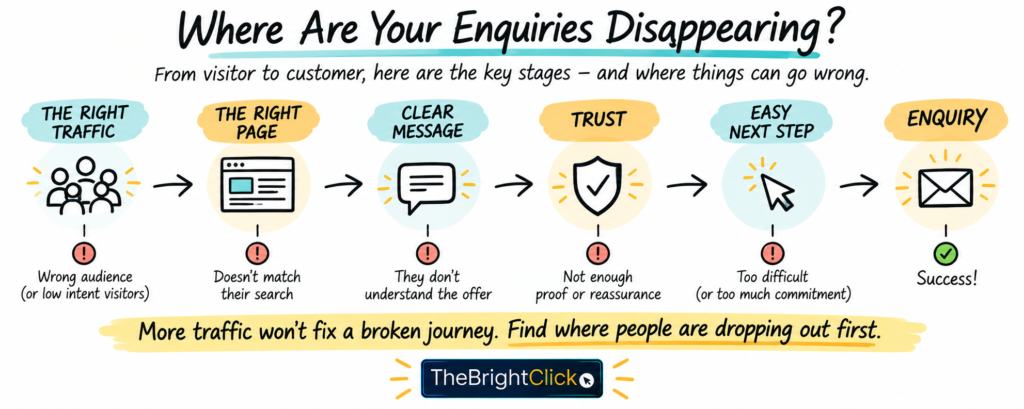
- Traffic quality – are potential customers actually reaching the site?
- Landing pages – are they arriving somewhere relevant to what they searched for?
- Clarity – can they immediately understand the offer?
- Trust – is there enough evidence to make them comfortable enquiring?
- Conversion journey – is the next step clear and proportionate?
- Forms and contact routes – is anything creating unnecessary friction?
- Mobile experience – does the journey work properly on a phone?
- Tracking – are enquiries actually being measured correctly?
- Lead quality and follow-up – what happens after somebody makes contact?
Only then would we decide what needs fixing.
Because until we know where people are dropping out, recommending a solution is mostly guesswork.
More Traffic Might Actually Make Things Worse
This is the part we’d really want a business owner to take away from this article.
If your website isn’t generating enough enquiries, don’t automatically assume you need more visitors.
If the traffic is poor quality, improve the targeting.
If people don’t understand the offer, improve the messaging.
If they don’t trust you, strengthen the proof.
If they want to enquire but the process is painful, remove the friction.
If the website is fundamentally wrong for the business, then look at rebuilding it.
And once those pieces are working? Then more traffic becomes much more valuable.
That’s a far better position from which to invest in something like Local SEO or paid advertising, because you’re no longer paying to pour more people into a journey that isn’t working.
The Bottom Line
Website traffic is only useful to a business if it contributes to something meaningful.
That doesn’t mean every visitor should become an enquiry. People research, compare, return later and visit for all sorts of reasons.
But if you’re consistently attracting relevant visitors and almost nobody takes the next step, there’s a problem worth investigating.
And the answer isn’t necessarily more SEO, more ads or a new website.
It’s finding the point between being found and being chosen where potential customers are disappearing.
We’re The Bright Click, a family-run digital marketing agency based in Staines-upon-Thames. We help businesses work out what’s actually stopping their marketing from producing results – whether that’s the traffic, the website, the message, the tracking or something else entirely.
If your website is getting visitors but not enough enquiries, get in touch with The Bright Click. We’ll look at what’s happening and tell you what we’d tackle first.