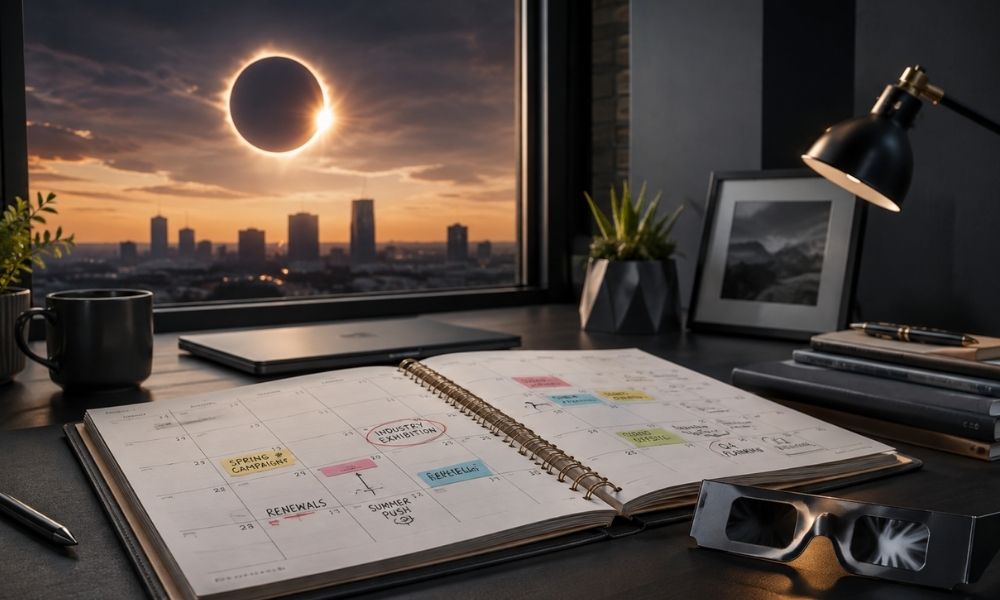
Unless you’ve been living under a rock for the last few weeks, you’ll probably have noticed there was a fairly significant solar eclipse last night.
And here’s what amused me about the whole thing.
We knew it was coming.
Not a few days ago.
Not when someone happened to look out of the window and notice the Sun disappearing.
We’ve known for years.
We knew the date. We knew roughly what time it would happen. We knew where you’d need to be to see it.
And yet, as the eclipse got closer, something entirely predictable happened.
Everyone suddenly decided they needed eclipse glasses.
They started selling out.
Prices went up.
People were desperately trying to find somewhere that still had them in stock.
Meanwhile, some rather entrepreneurial smaller businesses had clearly looked at the calendar, realised what was coming and started selling eclipse glasses while the demand was there.
Good luck to them.
Because that’s business.
See something coming.
Prepare for it.
Capitalise on it.
The funny thing is, we seem remarkably bad at doing this with events that are considerably more predictable than the Moon passing in front of the Sun!
Every year businesses act surprised that Christmas is coming.
Summer holidays arrive unexpectedly.
January goes quiet.
The schools break up.
An exhibition that’s been in the diary for nine months is suddenly three weeks away.
A contract comes up for renewal and everyone starts frantically trying to remember what we’ve actually done for the client.
Black Friday seems to catch half the country off guard despite the enormous clue being in the word Friday.
We know these things are coming.
Yet so much business and marketing activity is still reactive.
The businesses that do particularly well from seasonal opportunities aren’t necessarily doing anything revolutionary.
Quite often, they’ve simply started earlier.
The wedding venue creating its summer campaign while everyone else is thinking about Christmas.
The retailer preparing for Black Friday in September.
The accountant talking about tax deadlines months before everyone starts panicking about them.
The events business creating content before people start searching for the event.
The restaurant promoting Christmas parties before anyone has heard Mariah Carey in Tesco.
It’s the same with quieter periods.
If you know January is traditionally slow, don’t wait until January to start wondering where the business is.
Start generating it in October.
If you know your customers tend to disappear during August, plan for August.
If you’ve got a major exhibition in November, don’t start your marketing on the train there.
Most businesses have a calendar full of predictable opportunities.
We just don’t always treat them as opportunities until they’re almost upon us.
So here’s a little challenge for this week.
Look at the next six months.
What’s coming?
Christmas?
An exhibition?
A seasonal rush?
A traditionally quiet month?
A contract renewal?
Something happening within your industry?
Then ask yourself:
What could we start doing now that everyone else will suddenly wish they’d done three weeks beforehand?
Because sometimes being ahead of the competition isn’t particularly complicated.
You just need to look at the calendar.
And possibly buy your eclipse glasses before everyone else does.