This morning I was helping a potential client look at why their website wasn’t generating as many enquiries as they’d hoped, and it got me thinking about how much search behaviour has changed over the last couple of years.
Not that long ago, somebody looking for a service might type:
“accountant surrey”
or
“wedding venue hertfordshire”
into Google.
Three or four words. Nice and simple.
Now?
People are increasingly turning to ChatGPT, Claude, Gemini and other AI tools and asking questions more like this:
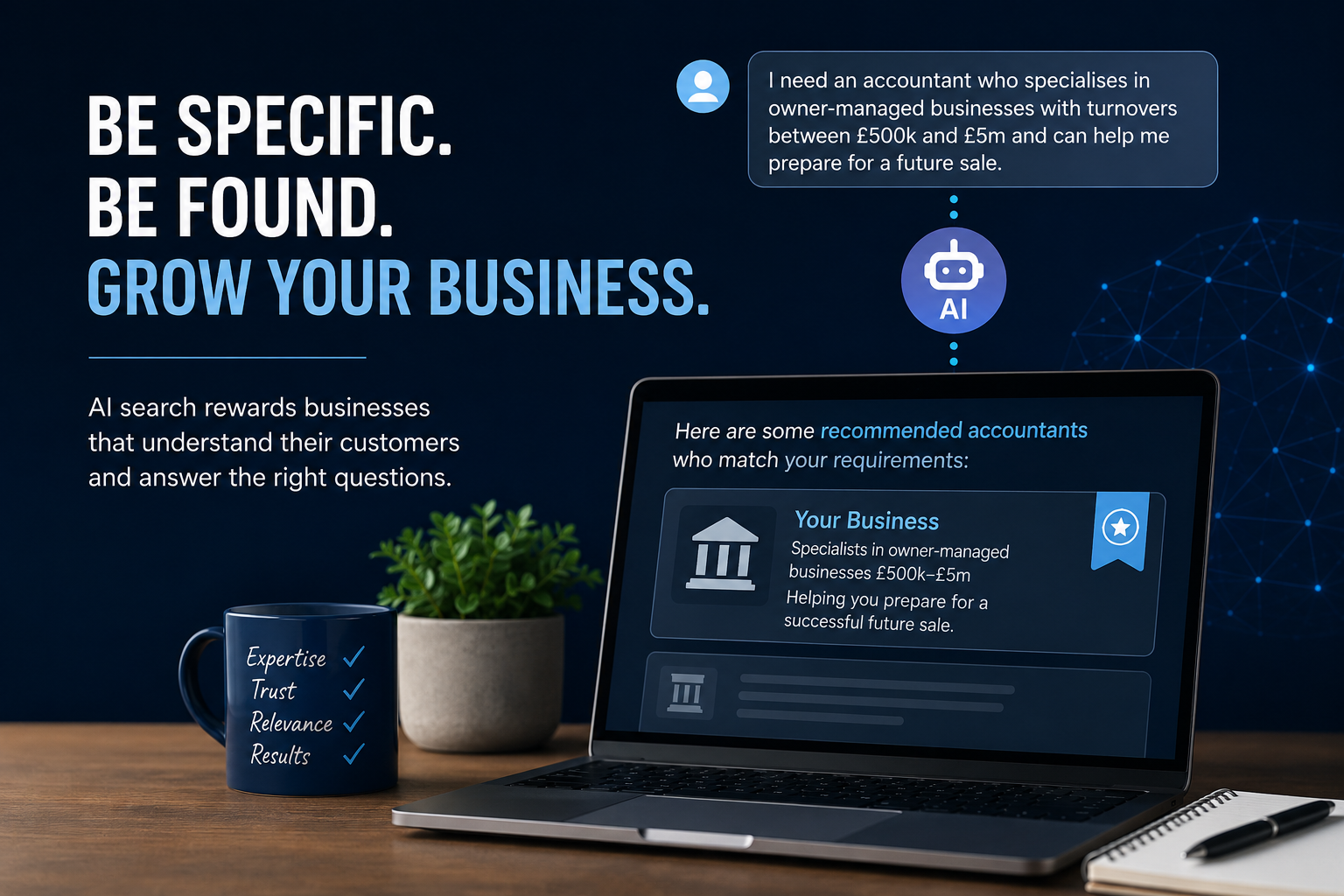
“I’m looking for an accountant who specialises in owner-managed businesses with turnovers between £500k and £5m and can help me prepare for a future sale.”
Or:
“I need a wedding venue near London that can accommodate 250 guests and has experience hosting Asian weddings.”
It’s a completely different way of searching.
And here’s the interesting bit…
This is actually good news for smaller businesses.
For years, many businesses have felt they needed to compete against huge national brands for broad search terms. The problem is that often requires a huge budget, a huge website and a huge amount of patience.
AI doesn’t necessarily work like that.
When somebody asks a very specific question, the platforms are looking for the most relevant answer.
Not the biggest company.
Not the loudest company.
Not the one with the biggest marketing budget.
The one that genuinely appears to understand that particular problem.
I’ve been involved in SEO and digital marketing for more than twenty years now and, despite all the hype around AI, the fundamentals haven’t really changed.
The businesses that win are still the businesses that:
• Understand their audience
• Answer genuine customer questions
• Demonstrate expertise
• Build trust
The difference is that AI is becoming much better at recognising who is genuinely knowledgeable and who is simply trying to rank for everything.
Which means that being a specialist has never been more valuable.
If you’re a solicitor who specialises in family law, a builder who specialises in extensions, an accountant who works with owner-managed businesses, or a hotel that excels at Asian weddings, that’s no longer something to hide away.
It’s something to shout about.
The more specific you are about who you help and how you help them, the easier it becomes for both search engines and AI platforms to understand where you fit.
And when they understand where you fit, they’re much more likely to recommend you.
Something worth thinking about.
As always, if you’re wondering how visible your business currently is within Google, ChatGPT and the growing number of AI-powered search tools, just hit reply and I’ll happily take a quick look.
No sales pitch.
No obligation.
Just a few thoughts on where you currently stand and what I’d do next.
Best wishes,
Matt